
If you subscribe to the saying that ‘What goes up must come down”, it should not be so hard for you to also believe that what goes up quickly will come down quickly.
Especially in cyberspace.
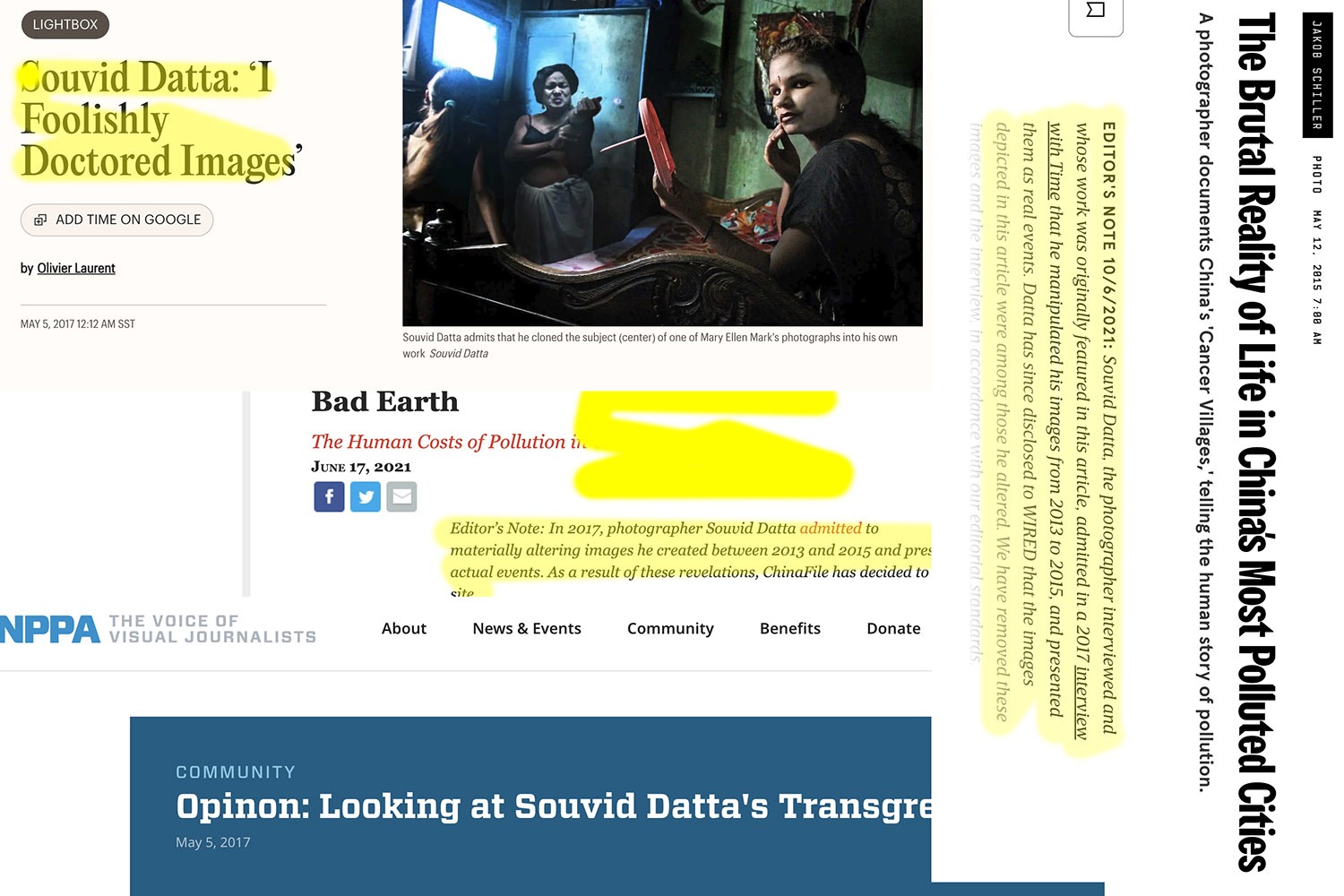
Ask Souvid Datta, he would know.
Before this week, many would consider the young Indian photographer a fast rising star in the world of photojournalism and documentary photography.
And then came one big revelation after another.
All things considered, he has been rather lucky, especially with the latest lengthy interview with TIME, where he was given a lot of airtime, which many argue he doesn’t deserve, to offer his side of story, and most of all, to express his regrets.
But many are asking, “Can he be believed?”, “Should he be believed?”, “Should he be forgiven?”
Well, having encountered much worse infringements in my career, I would say yes, let’s give Souvid a chance, if only for him to hang himself again, which I believe he is capable of.
Come on, bigger stars have done much worse and after the initial bashing, are they not on your pedestals again?
A lot of people seem to find his defense/excuse that he didn’t go through a proper journalism education or had proper journalism mentors problematic.
I actually don’t find that so unbelievable. Especially, ahem, in my part of the world.
When was the last time you had a proper discussion about ethics with your colleagues? Let me guess: Less than 24 hours ago. And the reason you had the discussion: Souvid.
Like it or not, ethics is often only a topic when someone screws up. But after the sudden bursts of opinions, the conversation dies down and we look for the next victim to further victimize.
Here is the scary thing many will be too courteous to tell you: Many professionals out there don’t give a fuck about photojournalism ethics, at least no more than their obsession with winning awards and recognition.
The situation is probably better in more developed communities like in the USA, where you can expect the full force of your peers to come down on you should you choose to muck around.
But in many other places, the good news and bad news is: many photographers are getting away with murder, until, ironically, when they become a global name, then they find themselves having to play with the global rules.
Two decades ago, the organization I was with and some of my colleagues were involved in a rather embarrassing episode.
In short, a staff photographer from my paper documented a wire agency photographer setting up an image at a polling station. Our boss complained to agency, resulting in severe disciplinary action on the unethical photographer. We had all the proofs on film and we thought we had done the profession a great service.
The next day, my boss was disciplined by his own boss for blowing the whistle on another organization. Our official complaint was recanted and the photographer who was reprimanded was unreprimanded.
Basically, ethics lost. The profession lost that day too.
Things haven’t change very much, I’m afraid.
Twenty years ago, it was common occurrences for people I worked with to brag about how they ‘made’ certain images happen. Many had no qualms boasting about the distance they went to create a picture. Try telling them setting up is unethical and wait for their reactions.
I don’t think that has changed very much.
So to the many young photographers who are crucifying Souvid and asking smugly, “What is so difficult to understand about photojournalism ethics?”, I would say: don’t assume what you know is correct.
Because in the name of getting the ‘right’ images, ethics can and have often become flexible. And that often is the argument for not doing something we are half-sure: because we are mere mortals who cannot stop once we get away with murder.
Use Souvid as a start of a meaningful discussion if you have to. But go beyond that.
Doing ethics means thinking about it all the time and making it part of your eco-system. Daily. 24/7.
Ethics should not be the 30 minutes fierce discussion you have everytime someone is stupid enough to fuck up so you can have that moment to reflect.
Because if you are not careful, you can easily become the reason for the next debate about ethics.


